
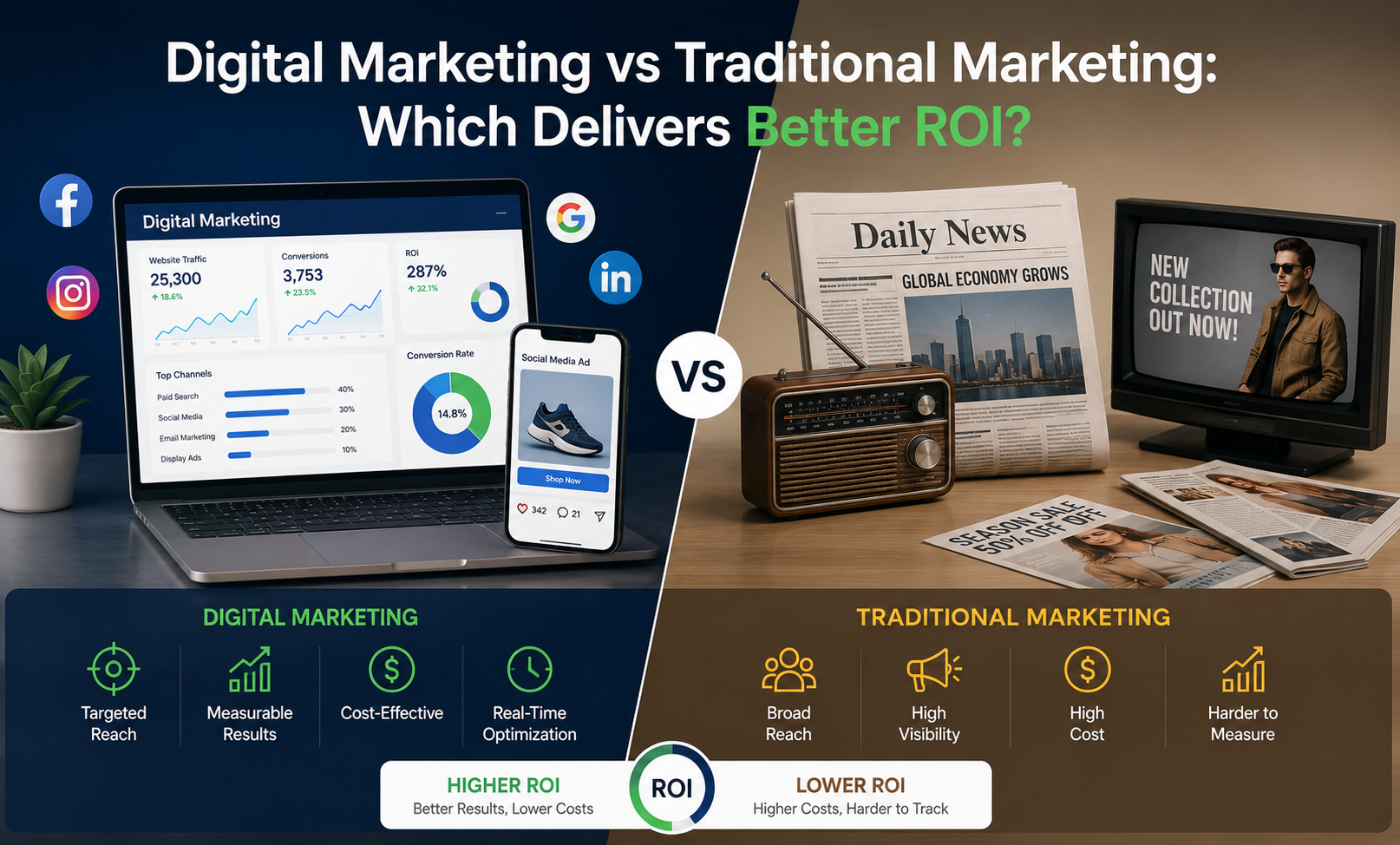
Digital Marketing vs Traditional Marketing: Which Delivers Better ROI?
Introduction
Imagine spending thousands on advertising without knowing exactly how many customers it generated.
For decades, businesses relied on television, newspapers, radio, billboards, brochures, and direct mail to reach their audiences. While these traditional marketing methods helped build strong brands, today’s business landscape has changed dramatically.
Healthcare providers compete for patient attention online. SaaS companies need scalable lead generation systems. E-commerce brands fight for visibility in crowded digital marketplaces. Coaching and education businesses must build authority and trust before attracting students.
Understanding Marketing ROI
Marketing ROI measures the income generated compared to the cost of marketing activities.
A strong ROI means:
• Lower customer acquisition costs
• More qualified leads
• Better conversion rates
• Higher profitability
• Maintainable business growth
Today’s businesses require marketing channels that not only create awareness but also generate measurable business outcomes.
This is where the comparison between digital marketing and traditional becomes especially important.
What Is Traditional Marketing?
Traditional marketing refers to promotional methods that existed before the rise of the internet.
Common examples include:
• Radio commercials
• Television advertisements
• Newspaper advertising
• Magazine advertising
• Flyers and brochures
• Direct mail campaigns
• Billboards
• Trade shows
• Event sponsorships
Traditional marketing remains valuable in certain situations, especially for local brand awareness and mass market exposure.
What Is Digital Marketing?
Digital marketing uses online channels to connect with potential customers.
Modern Digital Marketing Services include:
• Content Marketing
• Search Engine Optimization (SEO)
• Social Media Marketing
• Pay-Per-Click Advertising (PPC)
• Performance Marketing
• Email Marketing
• Video Marketing
• Website Optimization
• Influencer Marketing
Digital marketing allows businesses to track, measure, target, and optimize campaigns with unprecedented accuracy.
Common Marketing Challenges Across Industries
Before comparing both approaches, let’s examine common challenges faced by SaaS, E-commerce, Healthcare, and Coaching businesses.
Healthcare Industry
Healthcare organizations often struggle with:
• Patient acquisition
• Building patient trust
• Local visibility
• Compliance requirements
• Educating audiences
SaaS Companies
SaaS businesses face challenges such as:
• Customer retention
• Product education
• Long sales cycles
• Lead nurturing
• High competition
E-commerce Businesses
E-commerce brands frequently encounter:
• Cart abandonment
• Customer acquisition expenses
• Rising advertising costs
• Market saturation
• Brand differentiation
Coaching & Education Businesses
Education providers often need to:
• Generate consistent inquiries
• Build trust
• Establish authority
• Showcase expertise
• Increase enrollment rates
Traditional Marketing: Advantages and Limitations
Advantages of Traditional Marketing
Strong Local Presence
Billboards, local newspapers, and direct mail can effectively target specific geographic areas.
Brand Credibility
Many consumers still perceive traditional advertising as established and trustworthy.
Broad Audience Reach
Television and radio advertising can reach large audiences fast.
Tangible Marketing Materials
Printed brochures, catalogs, and direct mail create physical touchpoints with customers.
Limitations of Traditional Marketing
Limited Tracking
Measuring campaign effectiveness is difficult.
Lower Targeting Precision
Businesses often reach many people who are not interested in their services or products.
High Costs
Television, Radio, and print campaigns often require significant investments.
Slower Optimization
Campaign adjustments typically take longer compared to digital platforms.
Digital Marketing: Advantages and Limitations
Advantages of Digital Marketing Services
Highly Targeted Campaigns
Businesses can target audiences based on:
• Interests
• Behaviors
• Demographics
• Search intent
• Geographic location
This improves reduces and campaign efficiency wasted spending.
Real-Time Analytics
Digital platforms provide detailed performance insights including:
• Lead generation
• Conversion rates
• Website traffic
• Customer journeys
• Revenue attribution
Businesses can make informed decisions based on actual data.
Cost-Effective Marketing
Compared to many traditional methods, Online Marketing often requires lower upfront investment.
Even smaller businesses can compete effectively through strategic digital campaigns.
Better Lead Generation
One of the biggest advantages of Digital Marketing Services is reliable lead generation.
Businesses can attract potential customers through:
• Paid advertising
• SEO
• Content Marketing
• Email nurturing
• Social media campaigns
Scalability
Digital campaigns can be expanded fast as businesses grow.
This flexibility makes digital marketing ideal for fast-growing industries like E-commerce and SaaS.
Limitations of Digital Marketing
Continuous Changes
Algorithms and platform updates require ongoing adaptation.
High Competition
The digital marketplace is increasingly crowded.
Content Demands
Successful campaigns require consistent optimization and content creation.
However, these challenges are often manageable with the right strategy and expertise.
ROI Comparison: Digital Marketing vs Traditional Marketing
1. Cost Efficiency
Traditional Marketing
• Expensive media placements
• Higher production costs
• Large upfront investments
Digital Marketing
• Flexible budgets
• Lower entry costs
• Better spending control
2. Audience Targeting
Digital Marketing
Advanced audience segmentation and targeting capabilities.
Traditional Marketing
Broad audience exposure but limited precision.
3. Lead Generation
Digital Marketing
Designed specifically for conversion and lead capture.
Traditional Marketing
Can generate awareness but often struggles with measurable lead generation.
4. Measurability
Digital Marketing
Provides detailed performance reporting and analytics.
Traditional Marketing
Difficult to accurately measure performance.
5. Long-Term Value
Traditional Marketing
Brand awareness often disappears once campaigns end.
Digital Marketing
SEO and Content Marketing continue leads over time and generating traffic.
Industry Use Cases
Healthcare Example
A medical clinic invests in local search optimization and SEO.
Patients searching online for healthcare services discover the clinic through search engines.
The clinic receives qualified inquiries reliably without paying for every click.
Result: Higher ROI and lower acquisition costs.
SaaS Example
A software company uses LinkedIn advertising and Content Marketing.
Educational content attracts prospects researching solutions.
Automated nurturing campaigns convert leads into paying customers.
Result: Scalable lead generation and Predictable growth.
E-commerce Example
An online retailer combines social media advertising, SEO, and email marketing.
Visitors who abandon carts receive personalized follow-ups.
Result: Higher customer lifetime value and Increased conversions.
Coaching Example
A business coach shares educational content through blogs and social media.
Prospective clients engage with valuable insights before booking consultations.
Result: Steady lead flow and Strong authority.
Why Digital Marketing Delivers Better ROI in 2026
Several market trends continue to strengthen the effectiveness of Online Marketing.
Increased Online Consumer Activity
Consumers spend more time researching services and products online than ever before.
AI-Powered Marketing
Artificial intelligence improves personalization, targeting, and campaign performance.
Mobile-First Behavior
Customers increasingly use mobile devices to purchase products and discover.
Search-Driven Purchasing Decisions
Most buyers begin their purchasing journey through social media platforms or search engines.
Businesses that invest in Digital Marketing Services position themselves where customers are already spending their time.
The Role of SEO in Long-Term ROI
SEO remains one of the highest ROI marketing channels.
Benefits include:
• Improved brand visibility
• Sustainable traffic growth
• Lower acquisition costs
• Long-term lead generation
• Better conversion opportunities
Unlike paid campaigns, SEO continues delivering value long after content is published.
This makes it particularly valuable for SaaS, E-commerce, Healthcare, and Education businesses.
How EtherFly Services Helps Businesses Maximize ROI
At EtherFly Services, we help businesses build measurable, scalable, and growth-focused marketing :
Web Development
Build high-performing websites designed for conversions.
Branding
Create memorable brands that credibility and build trust.
SEO
Improve search rankings and attract high-intent traffic.
Social Media Marketing
Awareness, Increase engagement and customer relationships.
Performance Marketing
Measurable business growth and Generate qualified leads through data-driven advertising.
Our team develops customized Marketing Strategy solutions that align with maximize ROI and business goals.
Final: Which Delivers Better ROI?
While traditional marketing still has a place in certain industries and local campaigns, Digital Marketing Services consistently deliver stronger ROI for most businesses in 2026.
Digital marketing offers:
• Improved Lead Generation
• Better targeting
• Lower acquisition costs
• Real-time analytics
• Long-term growth opportunities
• Greater scalability
For SaaS companies, Healthcare providers, E-commerce brands, and Coaching businesses, investing in a modern Online Marketing strategy is often the most effective path toward maintainable growth.
The most successful organizations combine strategic planning, data-driven execution, and continuous optimization to achieve measurable business outcomes.
If you are looking to improve your marketing ROI and accelerate growth, EtherFly Services can help you build a customized strategy that aligns with your goals.
Visit us at: https://www.etherflyservices.com/
Leave a Reply